Compiler-aware protection for classic Visual Basic
Obfuscate Visual Basic 5.0 and 6.0 Applications
VB5/6 binaries preserve names and object relationships that make forms, classes, controls, events and procedures easier to recognize in a decompiler. DotFix NiceProtect rewrites this compiler metadata in both P-Code and Native Code applications.
Remove the semantic clues a decompiler relies on
A compiled Visual Basic application can retain descriptive names for forms, modules, classes, controls, events and public procedures. Names connected with registration, activation or passwords may lead an analyst directly to sensitive logic.
NiceProtect uses compiler-specific structural analysis derived from DotFix Software’s VB decompiler development to replace supported identifiers while preserving the relationships required by the application.

Randomized metadata for every protected build
Names are replaced with unrelated identifiers rather than a fixed set of aliases. The obfuscator processes the compiled binary, so protection can be added without redesigning the project solely to rename every visible symbol by hand.
Obfuscation supports both VB5/6 P-Code and Native Code output.
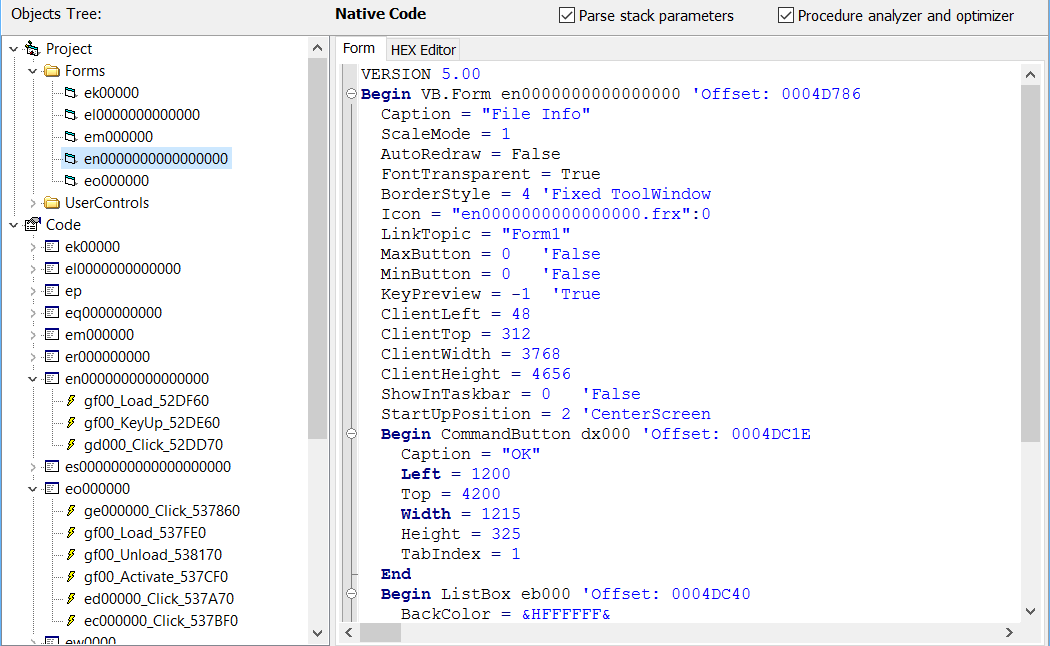
Protection available for P-Code and Native Code
VB5/6 P-Code
Metadata obfuscation, entry-point protection, anti-debugging, anti-tracing, packing and other applicable file-level defenses remain available. P-Code instructions themselves cannot be selected for virtualization or mutation through SDK markers or MAP files.
VB5/6 Native Code
Uses the same metadata and file-level protection layers. Native x86 code can additionally be selected through SDK markers or a matching compiler MAP file for virtualization and mutation.
Check string-based object references
In rare cases, VB6 code refers to a form or control by its original name at runtime. If that name is preserved as a string, renaming the corresponding metadata can affect the lookup. The official VB6 obfuscation restrictions describe examples of this pattern.
Test the protected application thoroughly: check its normal workflows after enabling metadata obfuscation. If a runtime lookup depends on an original object name, update that reference in your source code. If changing the source is not practical, disable compiler-metadata obfuscation and use NiceProtect’s other protection layers; obfuscation is one part of the protection pipeline.
See the protection in context
The illustrated NiceProtect 5.0 article compares VB metadata before and after protection and shows virtualization applied to native code. The architecture overview explains why compiler-aware rewriting differs from ordinary packing, and the version 26.1 article covers the current randomized naming engine.
Protect the structure of your VB5/6 application
Use the trial to evaluate metadata obfuscation and the protection layers available for your compilation mode.