Decompilation and program analysis
VB Decompiler for Visual Basic 5.0/6.0 Applications and .NET Assemblies
One workspace for decompiling VB5/6 P-Code and Native Code, translating MS IL from applications written in any .NET language into C#, disassembling x86/x64 unmanaged .NET code, and reconstructing application logic and user interfaces.
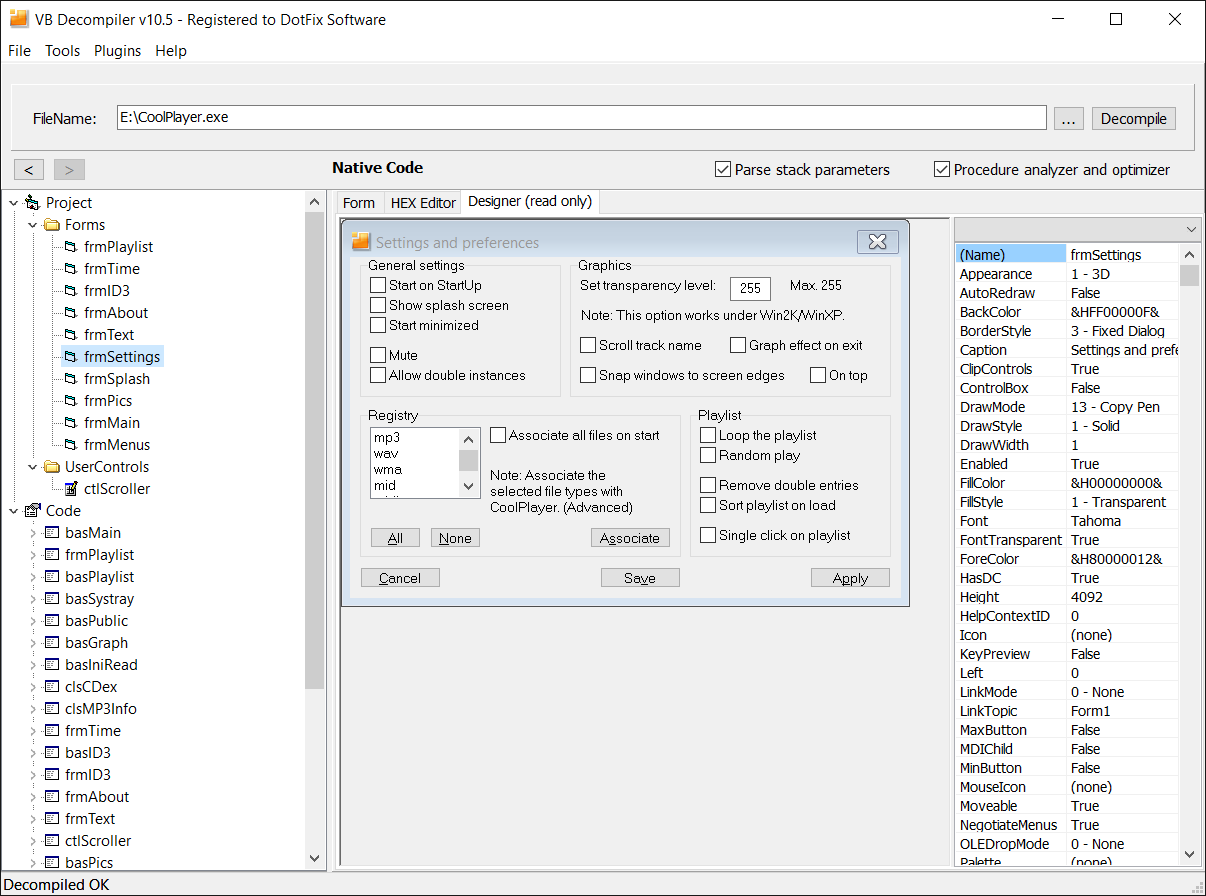
Three decompilation paths in one product
VB Decompiler provides dedicated analysis engines for both Visual Basic 5.0/6.0 compilation models - P-Code and Native Code as well as managed MS IL and x86/x64 unmanaged code found in .NET applications.
Visual Basic P-Code
Reconstructs high-level statements from roughly 1,400 P-Code commands, together with forms, properties, events, and calls into the Visual Basic runtime.
How P-Code decompilation works →Visual Basic Native Code
Combines machine-code disassembly and emulation with recognition of MSVBVM calls, conditions, loops, Select Case blocks, strings, and Windows API parameters.
Explore Native Code reversing →.NET MS IL to C#
Translates MS IL from C#, Visual Basic .NET, and other .NET languages into structured C#-style code. It handles unusual and obfuscated metadata without requiring the target .NET runtime or third-party .NET decompilation libraries.
Review .NET IL support →Unmanaged .NET code
Disassembles x86 and x64 unmanaged code embedded in .NET applications and connects it with the other views of the assembly under analysis.
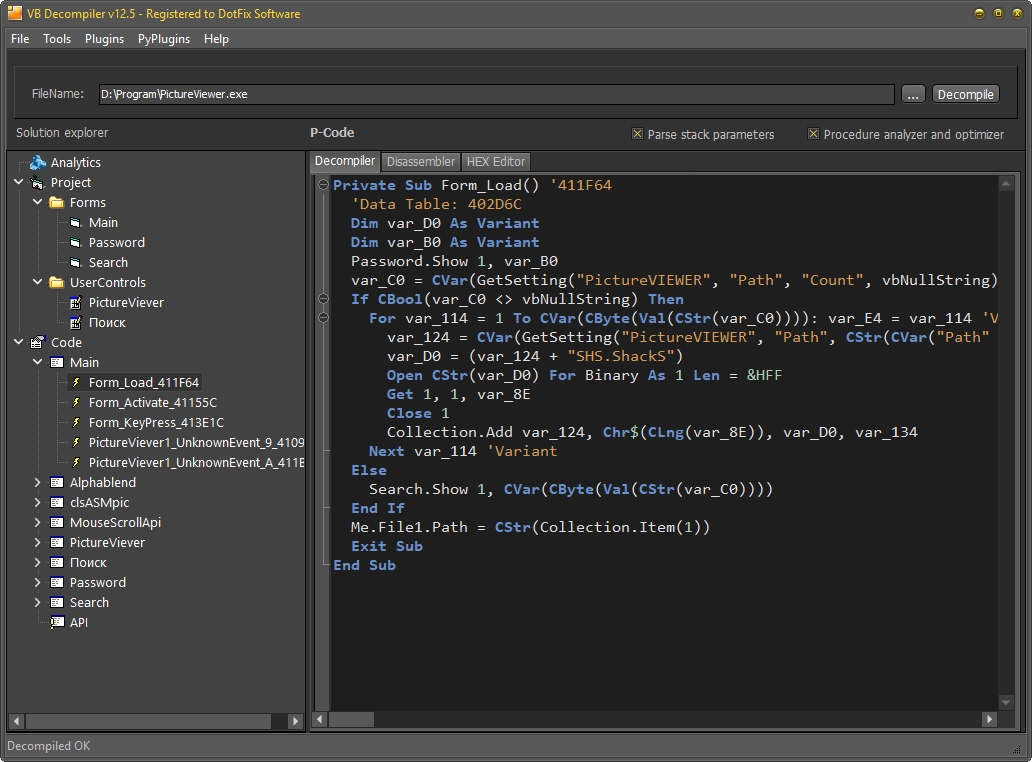
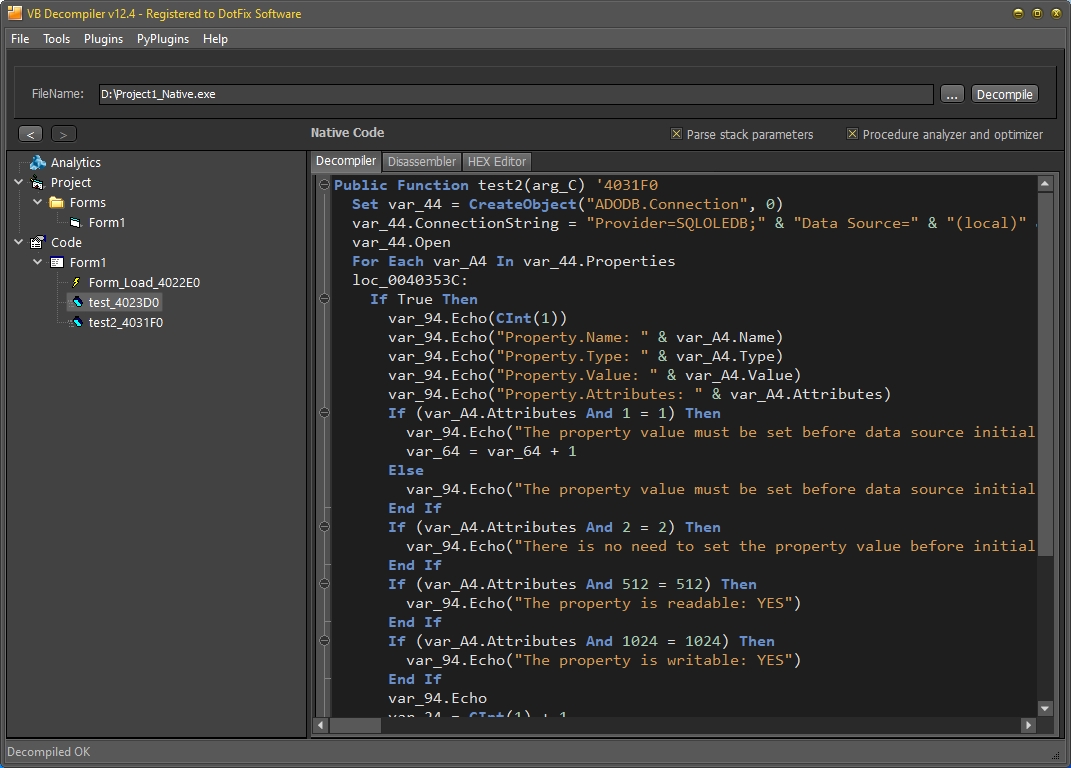
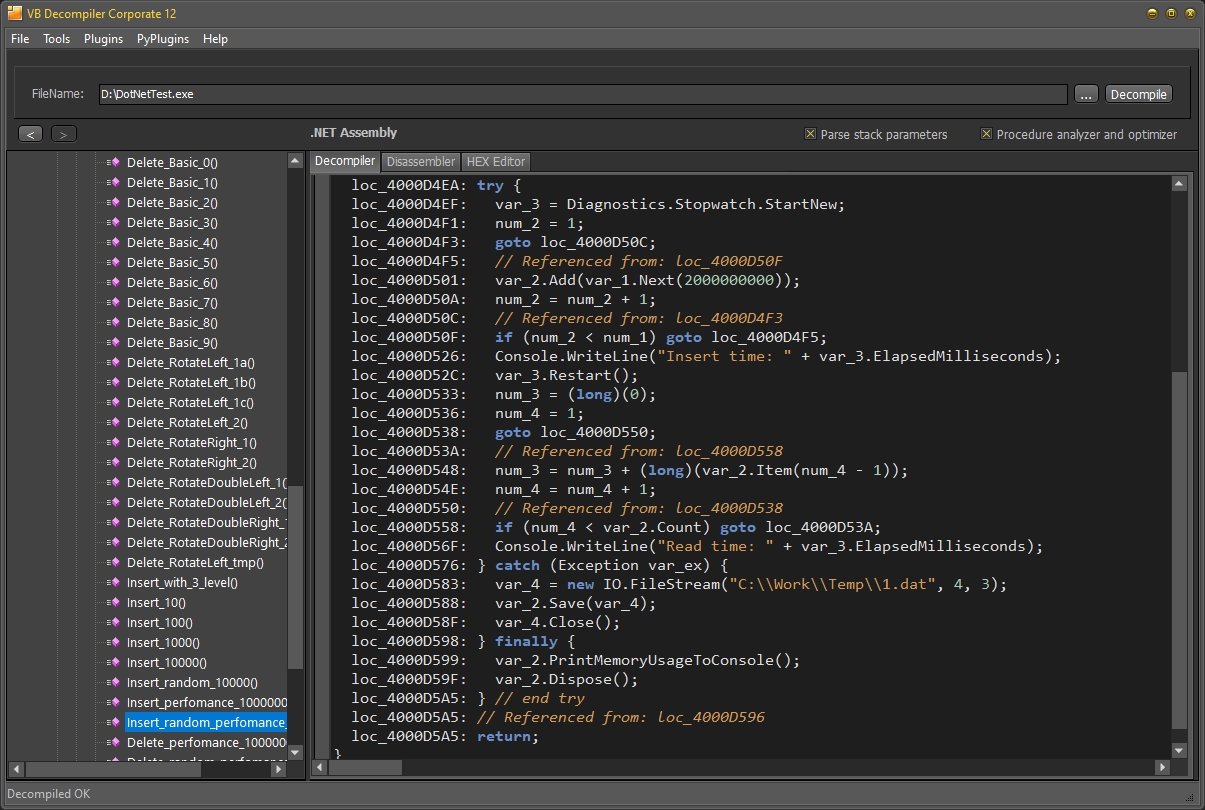
Reconstruct application logic and interfaces
The result is more than a set of isolated listings: VB Decompiler restores relationships between code, forms, controls, and events so you can move through the application as a connected project.
WPF and Windows Forms reconstruction
Reconstructs WPF windows, pages and user controls from compiled BAML, and renders Windows Forms without executing the analyzed application or loading its .NET runtime. The viewers recover controls, images, menus and layout structure; Windows Forms controls and events remain linked to their code.
See WPF reconstruction in v26.5 →VB5/6 forms and menus
Restores forms, UserControls, properties, and menu hierarchies from Visual Basic 5.0/6.0 applications compiled as either P-Code or Native Code.
C# decompilation optimizer
Reconstructs nested conditions, while, do-while, foreach, and other high-level constructs, simplifies expressions, and makes generated C# read more like conventional source code.
Explore the v26.1 C# optimizer →Project-wide navigation
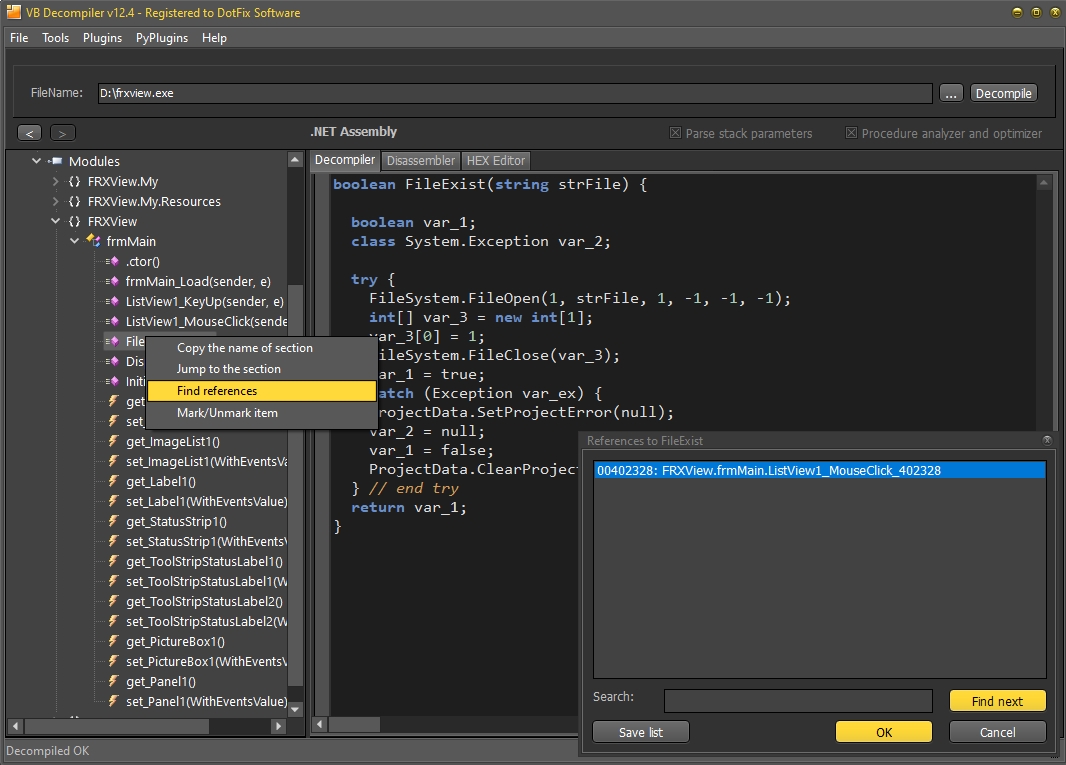
Find functions across an entire project, follow cross-references, move between decompiled and disassembled views, highlight syntax, and rename variables.
See .NET project search and navigation →Variant, SafeArray, and branch analysis
Three-tier Variant detection, multidimensional SafeArray support, branch-state snapshots, and COM interface heuristics improve reconstruction of complex VB Native Code.
Read about deeper Native Code analysis →


AI-assisted refinement and an extensible analysis environment
Built-in tools help turn raw decompilation output into clearer material for further manual analysis while leaving the underlying binary analysis to VB Decompiler itself.
AI Helper for C#, P-Code, and Native Code
Sends a selected decompiled fragment to an AI model for clearer names, structure, and presentation. It supports OpenAI ChatGPT, DeepSeek, Qwen, and local models served through Ollama.
Explore AI Helper →Plugin SDK
Extends the analysis workflow with custom modules, with examples for Visual C++, Rust, Delphi, and Free Pascal.
See the modern Plugin SDK →Embedded graphics viewer
Displays BMP, PNG, JPEG, GIF, ICO, and CUR images stored in VB5/6 FRX files and .NET Windows Forms resources, then exports selected graphics to disk.
See FRX Image Viewer in v26.1 →


Investigate behavior without running the target code
Specialized license tiers extend static decompilation with step-by-step emulation and automated reports for demanding reverse-engineering workflows.
Step-by-step emulation and tracing
Trace P-Code and Native Code inside the built-in emulator while observing registers, the FPU, stack, and variables without executing the analyzed instructions on the physical processor. Available in licenses that include Tracing or Analytic Features.
Explore tracing features →Automated analytic reports
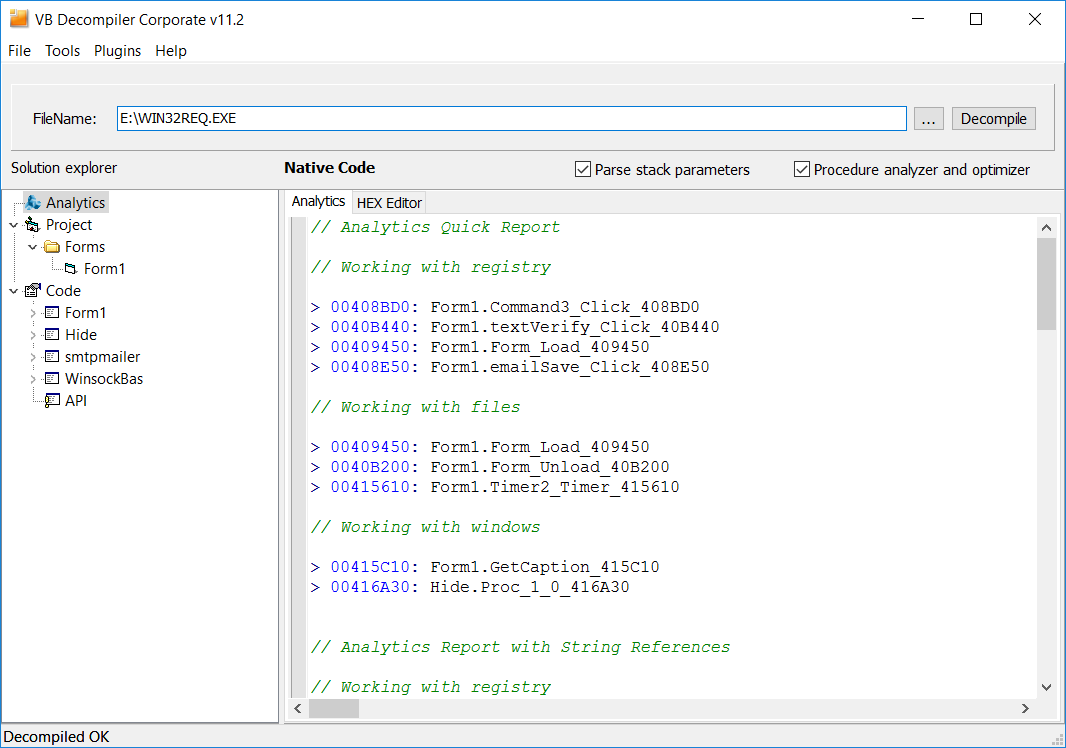
Statically identifies how an application works with files, the Registry, windows, processes, and Visual Basic APIs. Available in licenses that include Analytic Features.
Explore Analytic Features →Performance on large projects
Following the v26.3 engine refactoring, internal test cases showed up to 8× faster VB Native Code decompilation and up to 4× faster .NET decompilation, together with lower memory use and a more responsive interface.
Review the v26.3 performance work →Accessibility and keyboard operation
The interface supports complete keyboard navigation and works with the NVDA screen reader.
See the accessibility improvements →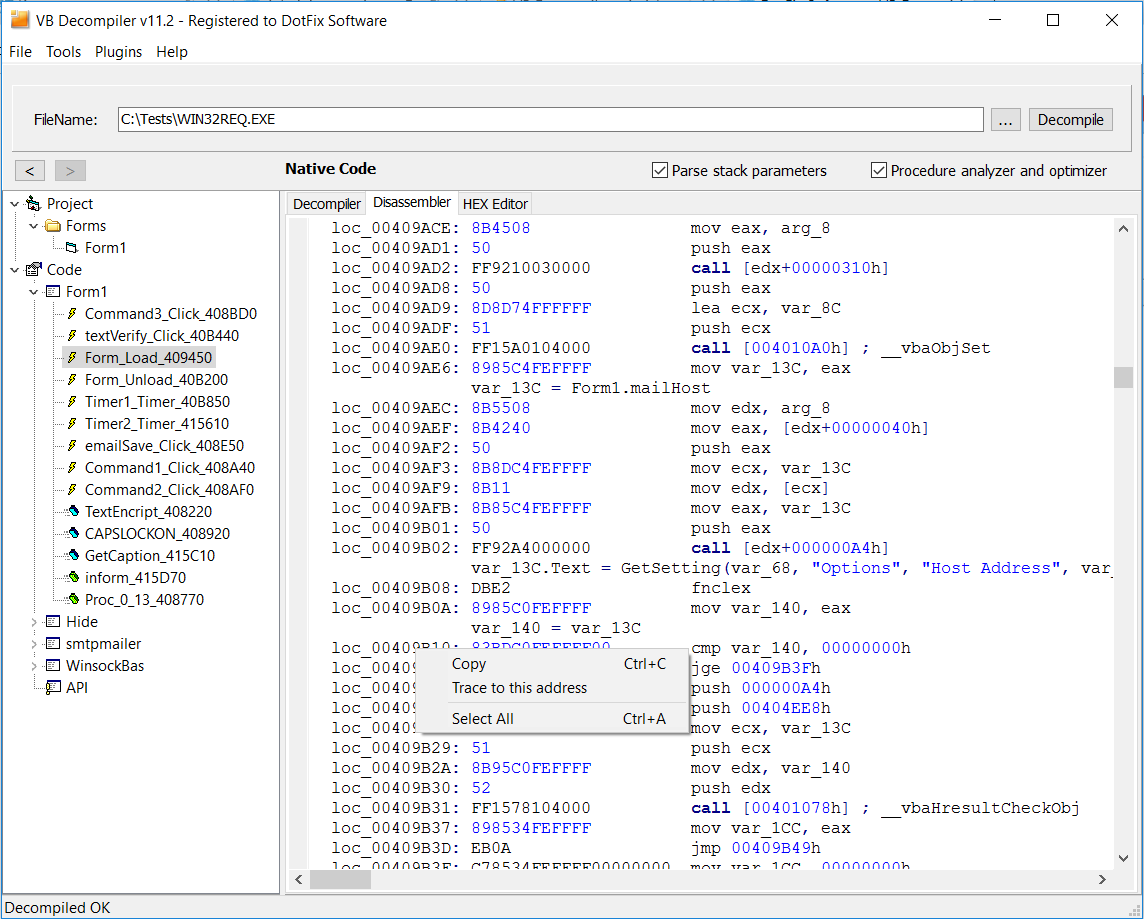

Evaluate the product with your own files
Download the trial, test the workflow that matters to you, and choose the license that includes the capabilities you need.
Product resources
Frequently Asked Questions
What is VB Decompiler?
VB Decompiler is a tool for analyzing, disassembling and decompiling applications created in Visual Basic 5.0/6.0 and .NET languages such as C# and VB.NET, including P-Code, Native Code and MSIL assemblies.
Which file types and platforms are supported?
VB Decompiler works with EXE, DLL and OCX modules built in classic Visual Basic 5.0/6.0 and modern C# .NET and VB.NET, and supports both x86 and x64 MSIL assemblies and native code.
Can VB Decompiler fully restore my source code?
VB Decompiler helps you partially recover source code and UI from compiled applications, with recovery rates of up to 85% for P-Code Visual Basic 5.0/6.0, up to 80% for Native Code Visual Basic 5.0/6.0, and up to 95% for C# .NET. It is intended to accelerate recovery, analysis or rewriting rather than promise complete restoration.
Who is VB Decompiler designed for?
The tool is intended for developers, reverse engineers, security researchers and support engineers who need to audit, maintain or understand existing C# or Visual Basic 6.0 applications without the original source code.
Does VB Decompiler support .NET applications?
Yes. VB Decompiler parses .NET assemblies, restores metadata tables, disassembles private and public methods compiled to MSIL or native code, and decompiles MSIL into a C#-like representation.